
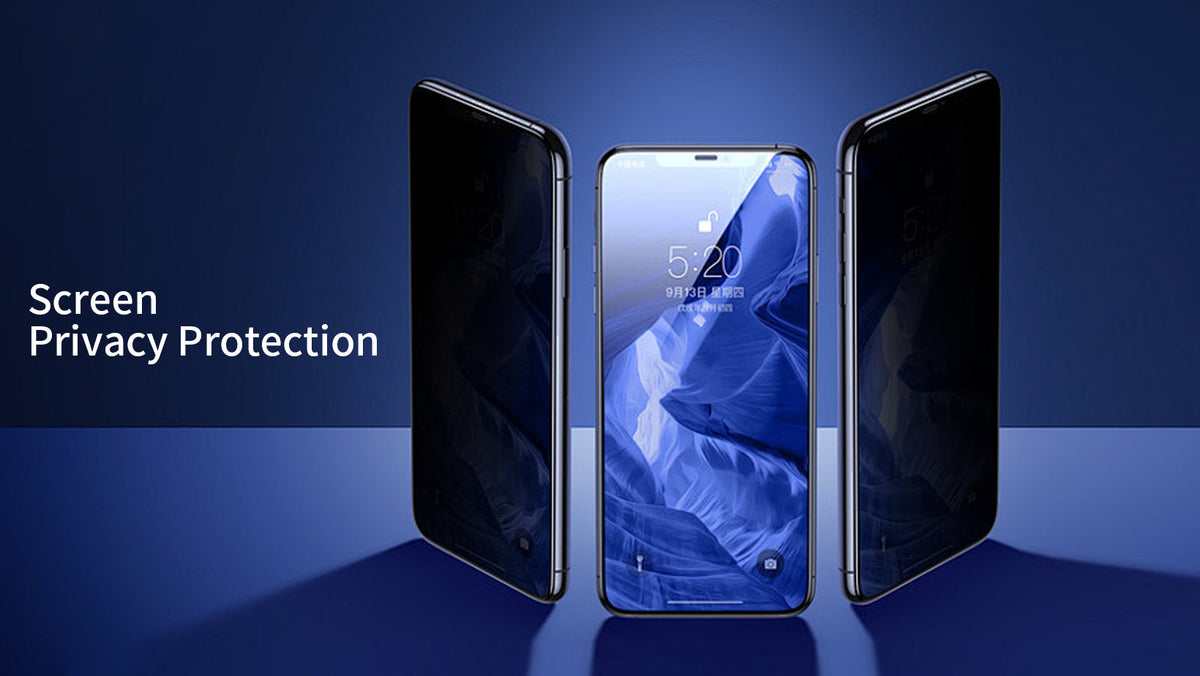
Your phone holds more personal information than ever—from private messages and emails to photos and payment details. But have you ever noticed how easily someone nearby can glance at your screen?
A privacy screen protector helps limit visibility from certain angles, giving you an extra layer of visual privacy.
However, not all privacy screen protectors work the same way. Two common options are 2-way and 4-way privacy screen protectors.
So, what's the difference, and which one is right for you? Let's find out.
What Is a Privacy Screen Protector?
A privacy screen protector is designed to reduce screen visibility from certain viewing angles while keeping the display readable when viewed directly.
Unlike a regular clear screen protector, many privacy protectors use micro-louver technology—microscopic structures that control the direction of light passing through the screen.
Think of it like tiny window blinds. When viewed straight on, your display remains visible. From restricted angles, the screen appears darker, making it more difficult for others to see what's on it.
However, privacy protection depends on the viewing angle, screen brightness, and product design. It doesn't make your screen completely invisible.
What Is a 2-Way Privacy Screen Protector?
A 2-way privacy screen protector restricts visibility from two opposing directions, typically the left and right sides when your phone is held vertically.
This design is ideal for users who primarily use their phones in portrait mode for messaging, browsing, and everyday activities.
Advantages of a 2-Way Privacy Screen Protector
-
Side-angle privacy: Helps reduce visibility from the left and right sides.
-
Comfortable everyday viewing: Generally offers greater viewing flexibility than a 4-way design.
-
Convenient landscape viewing: Makes it easier to share videos or photos when your phone is rotated.
-
Practical for daily use: Offers a balance between privacy and screen usability.
Limitations
A 2-way privacy screen protector mainly restricts one viewing axis.
When you rotate your phone into landscape mode, the privacy direction rotates with it. As a result, someone sitting beside you may have a clearer view of your display.
Best for: Everyday smartphone users who want side-angle privacy without significantly limiting viewing flexibility.
What Is a 4-Way Privacy Screen Protector?
A 4-way privacy screen protector restricts visibility from four directions: left, right, top, and bottom.
Unlike a 2-way design, it provides broader directional privacy, including when you switch between portrait and landscape orientations.
Advantages of a 4-Way Privacy Screen Protector
-
Broader privacy coverage: Limits visibility from both horizontal and vertical angles.
-
Portrait and landscape privacy: Offers more consistent protection when rotating your phone.
-
Additional viewing-angle protection: Helps reduce visibility from above and below.
-
Suitable for privacy-conscious users: A practical option for viewing personal or sensitive information.
Limitations
Because a 4-way privacy screen protector restricts more viewing directions, it may create a narrower comfortable viewing area.
Depending on its construction, it may also reduce perceived screen brightness more noticeably than a comparable 2-way protector.
Best for: Users who prioritize broader privacy coverage and frequently switch between portrait and landscape viewing.

2-Way vs. 4-Way Privacy Screen Protector: Key Differences
The main difference between a 2-way and a 4-way privacy screen protector is the number of directions from which screen visibility is restricted.
| Feature | 2-Way Privacy | 4-Way Privacy |
|---|---|---|
| Privacy directions | Left and right | Left, right, top, and bottom |
| Portrait-mode privacy | Yes | Yes |
| Landscape-mode privacy | Limited along the horizontal axis | More consistent |
| Viewing flexibility | Generally greater | More restricted |
| Screen brightness | Often less affected | Maybe more affected |
| Screen sharing | Generally easier | More difficult |
| Best for | Everyday privacy | Broader directional privacy |
Actual performance varies depending on the screen protector's design, materials, screen brightness, and viewing conditions.
While a 4-way privacy screen protector offers broader directional coverage, it isn't necessarily better for everyone. A 2-way protector may provide a more comfortable viewing experience for users who mainly use their phones in portrait mode.
Both types can reduce perceived screen brightness because privacy filters restrict the direction of light. The amount of dimming depends on the filter's construction and optical properties.
How to Choose Between a 2-Way and 4-Way Privacy Screen Protector
Choosing the right privacy screen protector comes down to three key factors.
1. Your Viewing Habits
If you mostly use your phone in portrait mode, a 2-way privacy screen protector may be sufficient.
If you frequently switch between portrait and landscape orientations, a 4-way design offers more consistent directional privacy.
2. Your Privacy Needs
For everyday side-angle privacy, a 2-way protector is often a practical choice.
For broader protection from multiple viewing directions, consider a 4-way protector.
3. Your Screen Experience
If you value screen brightness, viewing flexibility, and convenient screen sharing, a 2-way protector may be preferable.
If broader privacy coverage is your top priority, a 4-way protector may be worth the additional viewing restrictions.
Before purchasing, also make sure the protector is compatible with your exact device model.
Share:
How to Choose the Perfect Screen Protector for Your Eye Comfort